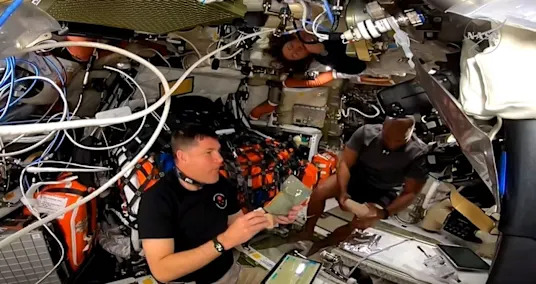
NASA has released the first images taken by the Artemis II crew during their historic trip around the far side of the moon.
The four astronauts — NASA commander Reid Wiseman, pilot Victor Glover, mission specialist Christina Koch and Canadian Space Agency mission specialist Jeremy Hansen — spent Monday’s seven-hour lunar flyby taking photos and making observations from the Orion spacecraft, which they named Integrity.
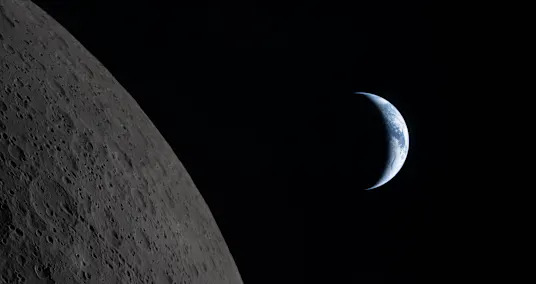
Among the stunning new images uploaded by NASA on Tuesday was a photo of “Earthset,” which was captured through the Orion capsule’s window at 6:41 p.m. ET, according to NASA.
"A muted blue Earth with bright white clouds sets behind the cratered lunar surface," the photo caption reads. "The dark portion of Earth is experiencing nighttime. On Earth’s day side, swirling clouds are visible over the Australia and Oceania region.”
Visible in the foreground is the moon, with the Ohm crater’s “terraced edges and a flat floor interrupted by central peaks,” per NASA’s description.

The crew also captured “Earthrise,” recreating the iconic photo taken during the Apollo 8 mission in 1968.

Also included in the new batch of images is a view of the solar eclipse that the crew experienced near the end of the flyby.

The astronauts donned eclipse viewers to protect their eyes during the nearly hour-long celestial event. But they still struggled to put into words what they were witnessing.

“Humans probably have not evolved to see what we're seeing," Glover told mission control. "It is truly hard to describe.”

Other photos captured close-up views of the lunar surface, including little-seen craters and basins from the vantage point of the crew, which at one point came within about 4,000 miles of the moon.
During Monday’s flyby, the Artemis II set a new record for the farthest distance from Earth traveled by humans — 252,756 miles, surpassing the previous mark set by Apollo 13 in 1970.


LATEST POSTS
- 1
 The most effective method to Move toward Compensation Conversations for Cutting edge Practice Enrolled Attendants
 - 2Grasping the Qualifications Among Separation and Dissolution
- 3Two Indonesian UN peacekeepers killed in explosion in Lebanon
- 4The Best 20 Photography Instagram Records to Follow
- 5Mountain Trekking on a Tight spending plan: Tracking down the Right Bicycle





- 10 Demonstrated Tips to Dominate Video Altering on Your Cell phone in 2023
- RFK Jr. says fewer flu shots for kids may be 'better.' What experts say.
- Top Music and Dance Celebration: Which One Gets You Going?
- 4 Jeep Models: Dominating Execution and Flexibility for Each Experience
- Germany ready to assist Syria's reconstruction, says foreign minister
- Why doing good also makes us feel good, during the holidays and beyond
- Schools to start reopening after Nigeria mass abduction
- Supportive Tips On Home loans For First-Time Home Purchasers
- An Artemis 2 astronaut took a 'bath' on camera on the way to the moon. Mission Control's reaction was priceless (video)